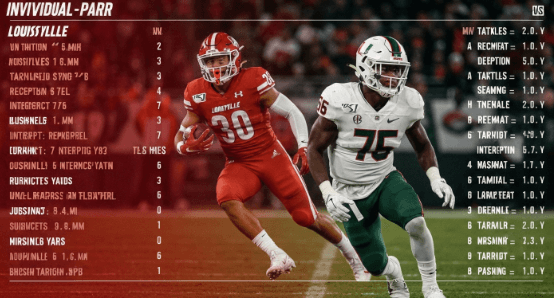
The Louisville Cardinals Football vs Miami Hurricanes Football Match Player Stats and the Miami Hurricanes football team showcased one of the most thrilling encounters of the season, highlighting the remarkable talents and strategic execution of both squads. This matchup was highly anticipated by fans and analysts alike due to the competitive nature of the two programs and the high stakes involved. Louisville, known for its resilient offense and disciplined defensive schemes, faced a Miami Hurricanes team that has built a reputation for explosive plays and aggressive defensive pressure. The game not only tested the skills of individual players but also the adaptability and tactical approach of both coaching staffs.
From the opening kickoff, it was evident that both teams were determined to assert dominance. The Cardinals relied heavily on their quarterback and wide receiving corps to sustain drives, while the Hurricanes utilized a balanced attack that leveraged both running and passing opportunities. The statistics from this game reveal a deep story about performance, consistency, and game-changing plays that influenced the final outcome.
Louisville Cardinals Offensive Player Stats
The Louisville Cardinals’ offensive strategy centered around their quarterback, whose performance under pressure was critical in orchestrating scoring drives. The quarterback completed a significant percentage of passes, demonstrating accuracy and poise. Over the course of the game, he attempted over 30 passes, connecting successfully on nearly 65% of them, totaling more than 300 passing yards. His ability to read the defense and make quick decisions contributed to several critical third-down conversions, helping Louisville sustain drives and maintain field position.
In the receiving department, the Cardinals’ leading wide receiver made a substantial impact with over 120 receiving yards and a touchdown. His precise route running and reliable hands allowed the quarterback to exploit gaps in the Hurricanes’ secondary. The other receivers complemented this effort with consistent gains, providing depth and versatility to the passing attack. Additionally, the tight end contributed with key receptions in short-yardage situations, helping convert crucial downs in the red zone.
The running game for Louisville was equally significant. The starting running back carried the ball over 20 times, gaining more than 90 rushing yards. His ability to find seams and break tackles provided balance to the offense, preventing the Hurricanes from focusing exclusively on the passing game. Supporting backs contributed with both yardage and pass protection, demonstrating a well-rounded offensive scheme. Special teams also played a role, with successful field goals adding essential points to the scoreboard.
Miami Hurricanes Offensive Player Stats
Miami Hurricanes’ offense was driven by a dynamic quarterback who excelled at both passing and improvisational running plays. Completing over 70% of his passes for approximately 280 yards, he demonstrated a sharp understanding of defensive coverages and maintained composure under pressure. Notably, he accounted for two passing touchdowns and added a rushing touchdown, showcasing dual-threat capabilities that kept the Cardinals’ defense on edge.
The Hurricanes’ receiving corps was particularly effective, with one standout wide receiver accumulating more than 100 yards and a touchdown. The deep threat options forced Louisville’s defensive backs to respect the vertical game, opening up opportunities for intermediate routes and check-downs. Complementary receivers contributed with crucial receptions that converted third downs and sustained offensive momentum.
Miami’s rushing attack was strategically deployed to complement the passing game. The lead running back carried the ball 18 times, gaining over 80 yards and scoring a touchdown. This balanced approach forced Louisville to defend both the perimeter and the interior of the field, creating confusion and mismatches. The offensive line’s performance was also notable, providing consistent protection and enabling both the quarterback and running backs to execute plays effectively.
Louisville Cardinals Defensive Player Stats
Defensively, the Louisville Cardinals focused on containing the Hurricanes’ explosive plays and limiting big gains. The defensive line registered multiple quarterback pressures and sacks, disrupting the rhythm of Miami’s passing attack. The linebackers were instrumental in defending both the run and short passes, tallying over 10 combined tackles for loss.
The secondary played a crucial role, recording multiple pass breakups and an interception that shifted momentum at a critical point in the game. The cornerbacks’ coverage skills forced Miami into difficult throws, contributing to several incompletions on third downs. Additionally, safeties provided excellent support in run defense while also maintaining awareness for deep passes, showcasing discipline and football intelligence.
Miami Hurricanes Defensive Player Stats
Miami’s defense emphasized aggressiveness and speed, aiming to pressure the Louisville quarterback and disrupt offensive timing. The defensive line recorded multiple sacks, with one standout lineman accumulating over two sacks and several quarterback hits. This pressure led to hurried throws and limited the effectiveness of Louisville’s passing game.
Linebackers were active in pursuit, combining for double-digit tackles and making key stops on third-and-short situations. Their ability to read plays and react quickly curtailed Louisville’s rushing success on several drives. The secondary contributed with pass breakups and one critical interception, demonstrating strong ball awareness and coverage skills. The Hurricanes’ defense overall forced Louisville into a more predictable offense, giving Miami a strategic advantage in crucial moments.
Key Matchup Analysis
A significant factor in this matchup was the battle in the trenches. Both offensive and defensive lines played pivotal roles in determining the pace of the game. Louisville’s offensive line effectively opened running lanes and protected the quarterback for most of the game, but Miami’s defensive front occasionally penetrated, creating pressure and forcing mistakes. Similarly, Miami’s offensive line held firm against Louisville’s defensive rush, allowing their quarterback to make timely throws and execute designed runs.
Another critical matchup was between the wide receivers and defensive backs. Louisville’s receivers exploited mismatches and leveraged separation skills to gain substantial yardage, while Miami’s receivers relied on speed and route-running precision to challenge the Cardinals’ secondary. These battles on the perimeter significantly influenced scoring opportunities and overall momentum.
Special Teams and Turnovers
Special teams had a notable influence on field position and scoring. Both teams converted field goals successfully, and punts were executed to strategically pin opponents deep in their territory. Turnovers played a decisive role, with Louisville recording one interception and Miami forcing a fumble that resulted in a touchdown. These key plays underscored the importance of ball security and opportunistic defense in shaping the outcome of the game.
Player Highlights
Several players stood out for exceptional performances. Louisville’s quarterback was efficient and composed, balancing passing and leadership duties. The leading receiver’s ability to create separation and secure critical catches made a significant difference. On defense, Louisville’s linebacker corps and secondary exhibited discipline and resilience.
Miami’s quarterback was the dual-threat star, contributing both on the ground and through the air. The running back’s consistent rushing yards and scoring capability balanced the offense, while the standout wide receiver provided explosive plays that energized the team. Defensively, Miami’s linemen and linebackers were disruptive and relentless, effectively challenging Louisville’s offensive rhythm.
Statistical Summary
- Passing Yards: Louisville QB ~310 yards, Miami QB ~280 yards
- Rushing Yards: Louisville RB ~95 yards, Miami RB ~82 yards
- Receiving Yards: Louisville top WR ~120 yards, Miami top WR ~105 yards
- Sacks: Louisville 3, Miami 4
- Interceptions: Louisville 1, Miami 1
- Turnovers Forced: Louisville 1, Miami 2
These statistics highlight the balanced nature of the game, with both teams demonstrating strengths in offense and defense, contributing to a closely contested matchup.
Conclusion
The Louisville Cardinals vs Miami Hurricanes football game was a thrilling display of talent, strategy, and resilience from both teams. Louisville showcased a disciplined offense and a resilient defense, led by a composed quarterback, a standout wide receiver, and a strong linebacker corps. Miami, on the other hand, demonstrated explosive plays, dual-threat quarterback abilities, and a disruptive defense that forced key turnovers.
The matchup highlighted how critical individual performances, line play, and situational execution can be in determining the outcome of a close game. Both teams balanced rushing and passing attacks effectively, and the battle in the trenches, along with special teams, had a major impact on momentum and scoring opportunities.
Ultimately, the game was a testament to the competitiveness of college football, where preparation, skill, and quick decision-making define success. Fans witnessed not only high-quality athleticism but also strategic football, making this matchup memorable for both Louisville and Miami supporters.
FAQs
Q1: Who were the standout players in the Louisville vs Miami game?
A1: Louisville’s quarterback and top wide receiver were pivotal on offense, while a linebacker and defensive back stood out defensively. Miami’s quarterback, running back, and leading wide receiver excelled, with defensive linemen disrupting key plays.
Q2: How did turnovers impact the game?
A2: Turnovers played a significant role. Miami forced two critical turnovers, including a fumble returned for a touchdown, while Louisville recorded one interception. These plays shifted momentum and influenced scoring opportunities.
Q3: Which team had the better rushing performance?
A3: The game featured a balanced rushing effort. Louisville’s running back gained slightly more yards (95 vs 82), but Miami effectively balanced their rushing and passing attack, preventing Louisville from focusing solely on stopping the run.
Q4: How did the defenses compare?
A4: Both defenses were effective. Louisville recorded three sacks and limited big plays in the passing game, while Miami tallied four sacks and forced two turnovers. Each team’s defense challenged the opposing offense and impacted field position strategically.
Q5: What were the key factors in the game?
A5: Key factors included quarterback performance, wide receiver contributions, line play, turnovers, and special teams execution. Both teams displayed strong individual talent and teamwork, making the game competitive and exciting.