amp100 transimpedance amplifier: A Practical Guide for Photodiode Sensor Readout

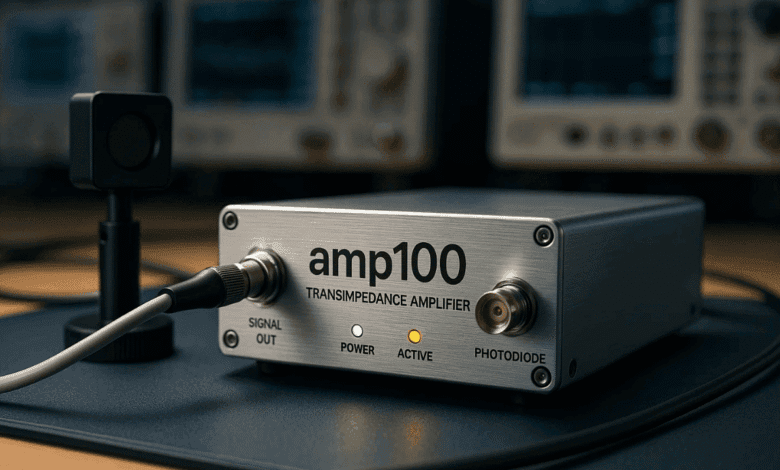
The amp100 transimpedance amplifier is a compact precision device designed to convert tiny currents from light sensors into usable voltages. For anyone building optical measurement setups, lab instrumentation, or sensor front ends, understanding how the amp100 transimpedance amplifier works, where it fits, and how to integrate it can save time and improve measurement quality. This guide explains core principles, practical design and buy considerations, module features, and best practices for use with photodiodes and reverse bias configurations.
Why current-to-voltage conversion matters for photodiode systems
Photodiodes produce current proportional to incident light. That current must be converted to a voltage for measurement or digitization. A transimpedance amplifier provides that conversion while maintaining a low input impedance and a predictable gain relationship. The amp100 transimpedance amplifier is one example of a dedicated solution that simplifies this front-end task, giving users selectable gain, offset adjustment, and an easy interface for common lab setups.
Key benefits of using a transimpedance amplifier with photodiodes
- Accurate current-to-voltage conversion with linear response.
- Low input impedance to keep the photodiode at virtual ground and improve speed.
- Ability to set gain to match the expected input current range.
- Offset adjustment to remove dark current and baseline errors.
Using a transimpedance amplifier photodiode pairing improves measurement stability and repeatability when working with low light levels.
Core features of the amp100 transimpedance amplifier
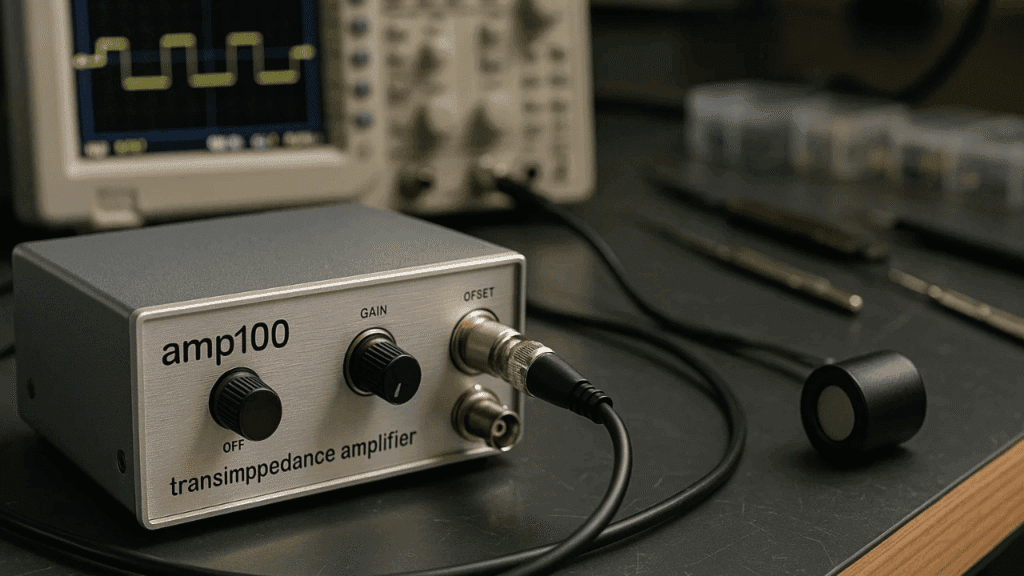
The amp100 transimpedance amplifier typically includes switchable gain stages, an adjustable zeroing control, and connectors suited for lab equipment. Those features make it a convenient transimpedance amplifier Module for research and instrument builders who do not want to design their own front-end electronics. Specific advantages include:
- Multiple gain settings to support a wide dynamic range.
- Zero adjust to trim output for dark current or background offset.
- Compact form factor with standard connectors for easy wiring.
These module features make the amp100 transimpedance amplifier an attractive choice when flexibility and simplicity are priorities.
Understanding transimpedance amplifier design essentials
Designing a transimpedance amplifier revolves around choosing the right feedback resistance and managing the capacitances that determine bandwidth and stability. The basic relation is straightforward: output voltage equals negative input current times the feedback resistor. But practical implementation requires attention to noise, stability, and component selection.
- Choose feedback resistor to produce a usable output voltage across your expected current range.
- Account for photodiode capacitance and wiring capacitance because these limit bandwidth.
- Add a small feedback capacitor in parallel with the feedback resistor to stabilize the loop.
A clear transimpedance amplifier design checklist helps avoid common pitfalls and ensures the amplifier performs as expected in real-world conditions.
Photodiode biasing: reverse bias vs zero bias and how it affects the amplifier
Many systems use reverse bias on the photodiode to widen the depletion region and reduce junction capacitance. A reverse bias photodiode transimpedance amplifier configuration can greatly increase speed and make higher gain usable without sacrificing bandwidth. However, reverse bias also increases dark current, so offset trimming and noise budgeting become more important.
- Reverse bias increases speed but can add dark current and noise.
- Photovoltaic (zero bias) mode minimizes dark current but reduces speed.
When pairing a photodiode with the amp100 transimpedance amplifier, selecting the bias mode depends on whether speed or lowest noise is the priority.
Practical integration tips for modules and custom builds
Choosing between buying a ready transimpedance amplifier Module and designing your own TIA depends on expertise, time, and required performance. Modules like the amp100 transimpedance amplifier offer convenience, documented performance, and integrated biasing and offset controls. Building your own transimpedance amplifier gives full control over components and optimization but requires careful layout and testing.
Practical tips:
- Keep photodiode wiring as short as possible to minimize stray capacitance.
- Use the module’s zero adjust to eliminate baseline offsets before measurements.
- When using switchable gain transimpedance amplifiers with adjustable zero voltage, verify stability and settling time after changing gain.
These steps help maintain signal integrity and avoid surprises such as oscillation or saturation.
How to select the right gain and bandwidth
Selecting the correct gain for a transimpedance amplifier is a balance between achieving a measurable output and maintaining enough bandwidth for the signal of interest. If the expected photocurrent is small, choose a higher gain. If the signal is fast, choose lower gain or a higher bandwidth amplifier.
Simple plan:
- Estimate the nominal input current from the photodiode.
- Decide on the desired output voltage swing.
- Compute a nominal feedback resistor and confirm bandwidth given the expected capacitances.
Modules with switchable gain transimpedance amplifiers with adjustable zero voltage make it easy to change gain without rewiring, which is particularly helpful during prototyping or when measuring in widely varying light conditions.
Buying guide: what to look for when you want to buy a transimpedance amplifier
When you decide to buy rather than build, pay attention to specifications that match your application. The phrase transimpedance Amplifier buy describes not just a purchase but an evaluation of trade-offs.
Important checklist:
- Gain and selectable gain ranges
- Bandwidth and frequency response
- Noise specifications and dynamic range
- Offset adjustment and photodiode bias capability
- Connector types and power requirements
Buying a module such as an amp100 transimpedance amplifier simplifies procurement because the product is tested and documented; still, confirm that its gain and bandwidth suit your specific sensor and application.
Common applications where amp100 transimpedance amplifier excels
The amp100 transimpedance amplifier is well suited for low-frequency precision work and laboratory sensors. Typical applications include:
- Spectroscopy and photometry where signals are steady or slowly varying
- Fluorescence detection where sensitivity is essential
- Sensor front ends that feed lock-in amplifiers or data acquisition systems
Because of its selectable gain and zero adjust capability, the amp100 transimpedance amplifier is versatile for many measurement scenarios.
Troubleshooting and common pitfalls
Even with a well-chosen module, problems may appear if setup details are overlooked.
Watch for:
- Saturation when light levels exceed the chosen gain setting.
- Excess noise at the highest gain settings due to resistor thermal noise and amplifier input noise.
- Stability issues if the feedback capacitor is not sized to compensate photodiode capacitance and op amp input characteristics.
If you follow the design checklist and use the module’s offset and gain features properly, most issues can be resolved quickly.
Quick comparison points to decide between module vs custom TIA
- Time to deploy: modules win for speed and convenience.
- Custom optimization: custom design wins for extreme bandwidth or ultra-low noise when you can optimize every part of the circuit.
- Flexibility: switchable gain transimpedance amplifiers with adjustable zero voltage offer the most flexible off-the-shelf compromise.
Choosing between buying and building depends on whether you prioritize speed to prototype or ultimate performance.
Conclusion
The amp100 transimpedance amplifier offers a practical, flexible solution for converting photodiode currents to voltages with selectable gain and offset control. Whether you use it as a transimpedance amplifier Module or draw lessons for your own transimpedance amplifier design, understanding how photodiode bias, feedback resistance, and capacitance interact will produce better measurement results. For many lab and instrument applications, the amp100 transimpedance amplifier strikes a balance between sensitivity, simplicity, and usability. When buying a transimpedance Amplifier, check gain, bandwidth, noise, and bias features to ensure the module fits your project needs
Frequently asked questions
- What is the primary function of the amp100 transimpedance amplifier?
The amp100 transimpedance amplifier converts small photocurrents into proportional voltages and provides selectable gain and offset control for sensor front ends. - Can the amp100 transimpedance amplifier work with reverse biased photodiodes?
Yes. Using a reverse bias photodiode transimpedance amplifier configuration increases speed and can improve bandwidth, though it may increase dark current. - Should I buy a transimpedance amplifier Module or design my own?
If you need speed and simplicity, buy a module. If you need extreme optimization for noise or bandwidth, consider designing a custom transimpedance amplifier. - How do switchable gain transimpedance amplifiers with adjustable zero voltage help in measurements?
They let you adapt gain for different light levels and trim baseline offset, allowing accurate readings across a wide dynamic range without redesigning the circuit. - What are common stability issues in transimpedance amplifier design?
Uncompensated photodiode and amplifier capacitances can cause oscillation. Adding a feedback capacitor and careful layout usually resolves stability problems.