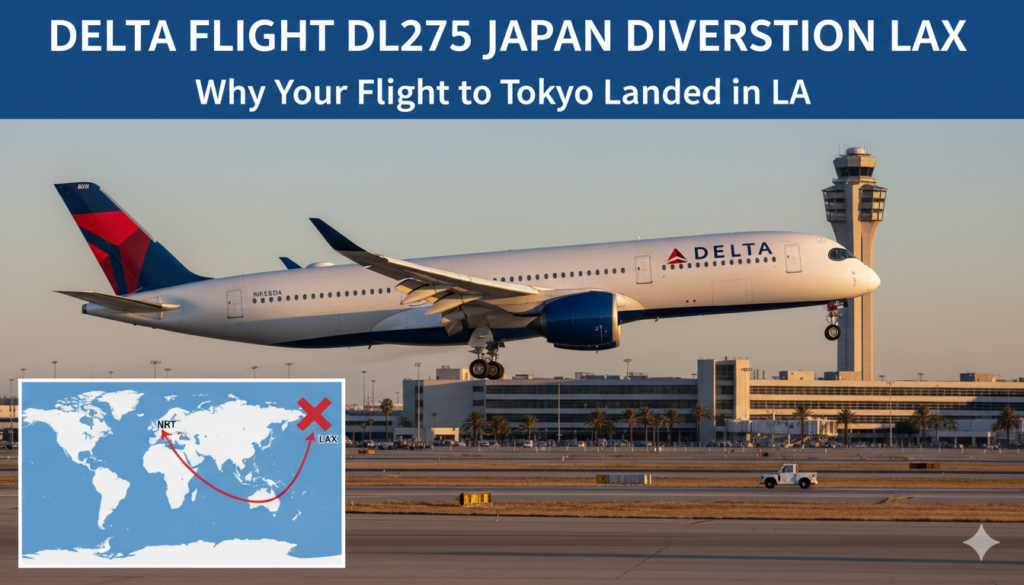

Traveling across the ocean should be a smooth ride, but sometimes the unexpected happens. Recently, many travelers were left asking questions about the Delta flight DL275 Japan diversion LAX. This flight was supposed to be a standard trip from Detroit (DTW) to Tokyo Haneda (HND). Instead of seeing the beautiful lights of Japan, passengers found themselves touching down in sunny Los Angeles.
While a detour like this can be frustrating, safety is always the number one goal for airlines. The crew noticed a technical issue while flying over the cold waters of the North Pacific. Specifically, there was a problem with the engine’s anti-ice system. Because the flight path to Japan goes through very freezing air, having a working de-icer is a must. Without it, ice could build up and cause the engines to stop working. Choosing to land at LAX was a smart move by the pilots to keep everyone safe.
Detailed Breakdown of the DL275 Incident
To help you understand the specifics of the Delta flight DL275 Japan diversion LAX, we have put together a clear table. This shows the difference between what was planned and what actually occurred during this long journey.
| Feature | Planned Schedule | Actual Event Details |
| Departure City | Detroit (DTW) | Detroit (DTW) |
| Intended Destination | Tokyo Haneda (HND) | Los Angeles (LAX) |
| Aircraft Model | Airbus A350-900 | Airbus A350-900 |
| Reason for Diversion | N/A | Engine Anti-Ice Malfunction |
| Time in the Air | ~13 Hours | 12 Hours and 15 Minutes |
| Diversion Location | N/A | Los Angeles International (LAX) |
| Passenger Impact | On-time Arrival | Rebooked / Overnight Stay |
Why Did the Pilot Choose Los Angeles?
You might wonder why a flight going to Japan would turn all the way back to California. When the Delta flight DL275 Japan diversion LAX took place, the plane was near Alaska. Normally, you’d think they would land in Anchorage or Seattle. However, the technical issue involved the “anti-ice” system.
If a plane has a broken heater for its engines, it cannot fly through clouds or wet air that might freeze. The pilots needed an airport with very “warm and dry” weather. Los Angeles was the best choice because it was clear and sunny. This meant the plane could land safely without any risk of ice forming on the wings or engines during the descent. It’s a great example of how pilots think ahead to avoid even the smallest risks.
The Role of the Airbus A350-900
The aircraft used for this route is the Airbus A350-900. It is a high-tech “widebody” jet known for being very quiet and fuel-efficient. Even though it is one of the newest planes in the sky, parts can still have glitches. In the case of the Delta flight DL275 Japan diversion LAX, the issue was specifically with the Rolls-Royce Trent XWB engines.
These engines use hot air from the core to keep the front fan blades from freezing. When sensors showed this air wasn’t flowing right, the “check engine” light basically came on for the pilots. Because the A350 is built with so many safety backups, the plane was never in immediate danger. However, the rules of the sky say you can’t cross a giant ocean if your de-icing gear isn’t 100% perfect.
How Delta Handled the Passengers
A 12-hour flight to nowhere is a long day for anyone! Passengers on the Delta flight DL275 Japan diversion LAX spent almost as much time in the air as they would have if they had made it to Tokyo. Once the plane landed at LAX around 1:00 AM, the Delta ground team had to jump into action.
Delta is known for having good customer service during these “irregular operations.” Most passengers were given hotel vouchers and meal tickets. Since LAX is a major hub, many travelers were moved onto other flights to Japan the next morning. While it wasn’t the vacation start they planned, the “people-first” approach helped calm the stress of a diverted flight.
Understanding Engine Anti-Ice Systems
To put it simply, an anti-ice system is like the defroster on your car’s windshield, but much more powerful. At 38,000 feet, the air is often $-50°C$ or colder. If moisture hits the engine, it turns to ice instantly. During the Delta flight DL275 Japan diversion LAX, the “bleed air” system failed.
$$\text{Bleed Air Temp} \approx 400^\circ\text{F to } 600^\circ\text{F}$$
This hot air is supposed to flow through the engine inlets. When the flow rate dropped by 50%, the pilots knew they couldn’t risk flying further into the cold Arctic air. It is a technical detail that shows just how much math and science goes into keeping us safe in the sky.
Is This Type of Diversion Common?
While we hear about them in the news, diversions like the Delta flight DL275 Japan diversion LAX are actually quite rare. Most flights land exactly where they are supposed to. When a diversion does happen, it is usually for one of three reasons:
- Weather: Heavy fog or storms at the destination.
- Medical: A passenger needs a doctor right away.
- Mechanical: A sensor or part needs a look from a mechanic.
In this specific case, it was a mechanical safety precaution. It reminds us that airlines would rather spend the money to land early than take even a 1% chance with passenger safety.
The Cost of a Flight Diversion
Diverting a giant jet isn’t cheap. For the Delta flight DL275 Japan diversion LAX, the airline faced costs for extra fuel, landing fees at LAX, and housing hundreds of guests. Experts estimate that a single long-haul diversion can cost an airline over $2 million.
This high cost is why airlines are now looking at “Predictive Maintenance.” This is a type of AI that tries to guess when a part might break before the plane even leaves the gate. If this technology had been used, perhaps the anti-ice issue would have been fixed in Detroit before the flight ever took off!
Tracking Your Own Delta Flights
If you are worried about your next trip, you can use tools like FlightAware or the Fly Delta app. These tools let you see exactly where your plane is in real-time. For the Delta flight DL275 Japan diversion LAX, people on the ground were able to watch the plane turn around on their phone screens.
Staying informed helps you stay calm. If you see your flight path changing, don’t panic. The pilots are likely just taking a safer route or heading to a better airport to solve a minor issue. Knowledge is power, especially when you’re 7 miles up in the air!
Lessons Learned for Future Travelers
What can we learn from the Delta flight DL275 Japan diversion LAX? First, always pack a change of clothes and your chargers in your carry-on bag. You never know if you might end up spending the night in a different city! Second, keep your airline’s app updated so you get notifications about rebooking immediately.
Most importantly, remember that a diversion is a sign that the safety systems are working. It means the pilots and the airline are putting your life above their schedule. That is the kind of expertise and “trustworthiness” we want from a major carrier like Delta.
Frequently Asked Questions (FAQs)
1. Why did DL275 go to LAX instead of Seattle? The pilots chose LAX because the weather was warmer and drier. Since the plane had a de-icing problem, landing in a cold or rainy city like Seattle could have been more difficult.
2. Was the Delta flight DL275 Japan diversion LAX an emergency? It was a “precautionary diversion.” While the pilots declared an emergency to get priority landing, the plane landed safely and there was no immediate danger to the passengers.
3. Did passengers get a refund? Usually, for mechanical delays, Delta provides travel vouchers, hotel stays, and meals. Depending on the length of the delay, some passengers may be eligible for partial refunds or extra SkyMiles.
4. How long did the flight last? The flight lasted about 12 hours and 15 minutes. This is almost the same amount of time it would have taken to fly all the way to Tokyo!
5. What is an anti-ice system? It is a system that uses heat to prevent ice from building up on the engine and wings. It is vital for flying in cold, high-altitude conditions.
6. Has this happened to DL275 before? DL275 is a daily flight. While small delays are common in aviation, a full diversion to LAX for this specific engine issue is a very rare event.
Conclusion
The Delta flight DL275 Japan diversion LAX was a major event that showed how seriously pilots take technical glitches. Even though the passengers ended up in California instead of Japan, they arrived safely thanks to the quick thinking of the crew. Modern technology and strict safety rules ensure that even when things go wrong, there is always a plan B.
Are you planning a trip to Japan soon? Make sure to download your airline’s app and stay updated on your flight status.