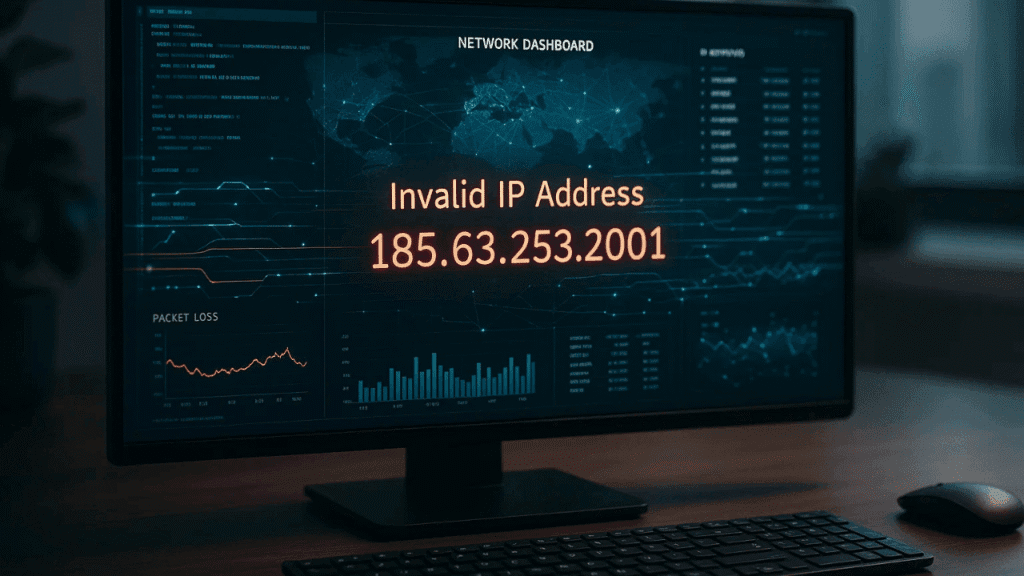

185.63.253.2001 might look like an IP address at first glance, but a closer inspection shows it is not valid under standard networking rules. For bloggers, system administrators, and curious readers, this example offers a straightforward way to explain IP address structure, common mistakes, troubleshooting steps, and potential security implications. In this article we will break down what makes 185.63.253.2001 invalid, why such mistakes happen, how to detect and fix them, and practical advice for preventing similar errors in real-world networks.
Internet addresses follow clear rules. When a string like 185.63.253.2001 appears in logs, configuration files, or forum posts, it should trigger a quick validation check because it violates the expected format for IPv4 addresses. This article starts by explaining the IP address format, then moves to case studies and troubleshooting, and finishes with security and best-practice recommendations.
How standard IPv4 numbering works and why 185.63.253.2001 fails validation
Internet Protocol version 4 (IPv4) uses a dotted decimal format composed of four numbers separated by dots. Each number, called an octet, ranges from 0 to 255. That limit exists because each octet represents 8 bits, and a value of 255 corresponds to eight binary ones. The example 185.63.253.2001 breaks these rules because the last segment, 2001, is far above 255. Any system expecting a valid IPv4 address will reject 185.63.253.2001 or return an error.
Common signs that an address is invalid:
- A segment is larger than 255 (as with 2001 in 185.63.253.2001).
- Too few or too many segments.
- Use of characters or symbols not allowed in dotted decimal notation.
Why typos and misconfigurations produce entries like 185.63.253.2001
Human error is a major source of malformed addresses. A network administrator typing a static route, a developer pasting configuration values, or a user copying text from an email can accidentally insert an incorrect value. In some cases, formatting or transcription errors convert a valid address into an invalid one. For example, an intended IPv4 address such as 185.63.253.200 could have an accidental trailing “1” appended, creating 185.63.253.2001.
Other causes include:
- Confusing IPv4 and IPv6 formats.
- Automated scripts that concatenate numbers incorrectly.
- Data entry systems that lack input validation.
- Copy/paste mistakes from logs or documentation.
Differences between IPv4 and IPv6 so examples like 185.63.253.2001 cannot be IPv6
IPv6 uses colons and hexadecimal groups rather than four decimal octets. A valid IPv6 address looks entirely different from 185.63.253.2001, so this string cannot be interpreted as IPv6. Understanding the distinction helps when troubleshooting: if a system expects an IPv6 address but receives a dotted decimal string, or vice versa, the configuration will fail. This reinforces the need to keep address formats clear in documentation and user interfaces.
Practical troubleshooting steps when you encounter 185.63.253.2001 in logs or configs
If you find 185.63.253.2001 in a configuration file, routing table, or server log, follow these steps:
- Pause and validate the segment count and ranges — check each octet is between 0 and 255.
- Search recent edits or commit logs to see who or what inserted the value.
- Replace the invalid string with the intended address, if known, or comment the line out until the correct value is available.
- If unsure what the intended address was, look for nearby configuration entries or defaults to infer the correct number.
- Run validation tools or simple scripts to scan other files for similar mistakes.
Simple validation checks can stop accidental network outages. For those managing multiple devices, adding automatic validation before pushing configurations is an efficient safeguard.
Example remedies and automation tips to prevent 185.63.253.2001-type mistakes
To reduce future errors, implement automation and validation:
- Use configuration management tools that validate IP formats before applying changes.
- Add unit tests or pre-commit hooks that run simple IP validation scripts.
- Provide form validation in any web interfaces used for entering network addresses.
- Educate staff with quick checklists that encourage double-checking segments and context.
Automation not only prevents entry of 185.63.253.2001-style errors but also improves overall configuration reliability.
Security considerations when malformed addresses like 185.63.253.2001 appear
While 185.63.253.2001 itself is a simple formatting mistake, malformed addresses can have security consequences. An attacker could deliberately inject invalid addresses to create confusion, trigger errors, or hide malicious routing instructions within logs. Misconfigurations may also leave devices temporarily unreachable, opening windows for exploitation if monitoring and remediation are delayed.
Key security actions:
- Treat unexpected or malformed addresses as indicators for investigation.
- Correlate such entries with user activity and change logs.
- Keep access controls strict around systems that manage routing and DNS entries.
User-friendly explanations and analogies to make the concept clear to non-technical readers
For a general audience, analogies help. Think of an IPv4 address as a postal address with four house numbers — each must be within a valid range. Writing 2001 in the fourth position is like writing a five-digit house number where only numbers up to 255 are valid for that block. Using short analogies like this makes technical details accessible and reduces accidental mistakes when non-specialists handle network details.
Quick checklist for detecting and correcting 185.63.253.2001 and similar errors
- Verify each dotted segment is 0–255.
- Confirm there are exactly four numeric segments for IPv4.
- Ensure the address format matches IPv4 or IPv6 expectations.
- Check recent changes or commits when an invalid value appears.
- Use validation tools in automated workflows.
Case study example: a mis-typed configuration and the cost of ignoring it
Imagine a small company where an administrator updates firewall rules and accidentally types 185.63.253.2001 into an allow list. Because the entry is invalid, traffic routing behaves unpredictably and monitoring alerts begin to pile up. Time spent diagnosing the issue and restoring correct settings could have been avoided with a simple validation step in the deployment process. This scenario highlights how a single misplaced digit can become costly.
Best practices summary to avoid seeing 185.63.253.2001 in your systems
- Adopt automated input validation for network configurations.
- Use clear documentation that differentiates IPv4 and IPv6 formats.
- Train team members on common mistakes and verification steps.
- Keep an audit trail for changes to networking and firewall settings.
- Periodically scan configurations for anomalies.
Conclusion
185.63.253.2001 is a useful teaching example because it clearly violates the rules for IPv4 addresses and prompts discussion about validation, troubleshooting, and security. Recognizing why 185.63.253.2001 is invalid helps teams avoid configuration errors, reduce outages, and adopt preventative measures like automation and validation. Whether you are writing a blog post, training a new administrator, or cleaning up configuration drift, using concrete examples such as 185.63.253.2001 makes the lessons memorable and actionable.
Frequently Asked Questions
- What specifically makes 185.63.253.2001 invalid?
The last segment, 2001, exceeds the allowed maximum of 255 for an IPv4 octet, so it does not conform to the required four-octet format where each octet must be between 0 and 255. - Could 185.63.253.2001 ever be a valid IPv6 address?
No. IPv6 addresses use colons and hexadecimal groups, not four decimal octets separated by dots, so the format of 185.63.253.2001 does not match IPv6 syntax. - If I find 185.63.253.2001 in my logs, what immediate steps should I take?
Validate the entry, check recent changes or commits, remove or comment out the invalid line, and replace it with the correct address once confirmed. Also review whether the error indicates a systematic issue with input validation. - How can I prevent errors like 185.63.253.2001 in large environments?
Implement automated validation in your configuration management pipeline, add pre-commit checks, and train staff to follow verification checklists before applying changes. - Are malformed addresses like 185.63.253.2001 a security risk?
They can be. While often accidental, malformed addresses may be used to obfuscate malicious activity or could cause unexpected behavior. Treat them as indicators for further investigation and maintain strict controls over configuration changes.